

Whole Setting
Approach
Learn about the whole setting approach to emotional health and mental wellbeing within education.
Where we find ourselves
The demand for children and young people's mental health services is greater than ever.
The NHS estimates that in 2023 approximately 1 in 5 children had a probable mental health condition, a stark increase from 1 in 8 in 2017.i Research suggests many factors may have attributed to this rise for example, the legacy of the COVID-19 pandemic,ii and the cost-of-living crisis with more than 1 in 3 UK children now living in poverty.i, iii, iv, v
It is unsurprising then there has been a substantial increase in children and young people's referrals and contact with mental health services.vi, vii While services are often seeing far more children and young people, pressures due to increased demand, complexity and the severity of need mean that many children in distress are still experiencing long waits to receive the right support.vi, vii
Getting it right matters. Childhood is a critical period of our lives in terms of cognitive, health and social development and poor mental health has long-term impact.
Research suggests poor wellbeing in childhood is associated with poorer academic achievement and engagement, as well as lower life satisfaction and quality of life in adulthood.viii-xi
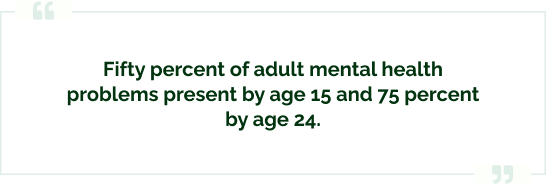
Fifty percent of adult mental health problems present by age 15 and 75 percent by age 24.xii Meeting the mental health needs of children is therefore crucial to ensure every child can make a successful transition into adulthood.
Every child has the right to a safe and healthy childhood and education settings have a statutory duty to promote the welfare of pupils. xiii-xiv However, the impact that the current crisis in children's mental health is having on our schools and colleges is undeniable.
Many staff view they receive inadequate support from public bodies to meet the needs of students placing the workforce under increasing strain.xv
Workloads continue to rise with staff reporting they are helping pupils more with personal matters than they did 5 years ago.xv-xvii. They are more frequently responding to disruptive and challenging pupil behaviour; dealing with pastoral duties; supporting vulnerable pupils and their families, including those requiring special educational needs and disability (SEND) support or experiencing safeguarding issues; and liaising with other professional agencies.

The increased job demands are negatively impacting the mental health of the workforce and many staff report not having access to appropriate support for their wellbeing.
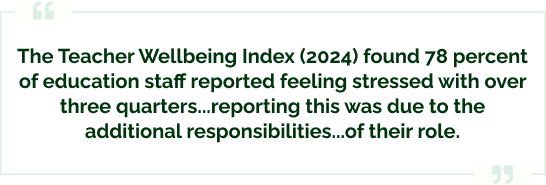
The Teacher Wellbeing Index (2024) found 78 percent of education staff reported feeling stressed with over three quarters of these respondents reporting this was due to the additional responsibilities and demands of their role.xv, xvii Compared to the general population respondents were also experiencing higher levels of depression and anxiety, supporting national data that in 2023-24 these conditions accounted for 49% of all work-related ill health within the sector.xv, xviii
At the same time, of those surveyed half considered their organisation’s culture had a negative effect on staff health and wellbeing, and nearly half felt that their organisation failed to adequately support employees who had mental health problems.xv Many staff also report offering emotional support to colleagues without feeling they have the skills to do so.xviiii This suggests despite staff facing the negative impacts of rising jobs demands, many are left feeling unable to gain the support they need.
Addressing the wellbeing needs of staff may have the additional benefit of helping improve pupil mental health and be a positive step to increasing staff recruitment and retention.
Poorer teacher wellbeing is associated with poorer student wellbeing and greater student psychological distress.xx Teachers with poorer wellbeing may be less likely to believe they can support students with emotional problems and be less able to develop supportive teacher-student relationships or manage classrooms effectively, all of which may negatively impact on student mental health.xxi- xxvii
Alongside this, educators are leaving the profession. The Working Lives of Teachers and Leaders Survey found 36 percent of respondents in 2022/23 intended to leave the profession in the next 12 months.xvii This is in a national context of ongoing teacher undersupply and below-target level recruitment. xvi Poor wellbeing and high workloads are often cited as the main reasons for those who have left the sector signalling these are crucial areas to target for intervention.
We understand the challenge and we can choose how to respond.
Current guidance recommends this response takes a whole setting approach. xxviii- xxxi
A whole setting approach involves pupils, staff, parents and carers, the community and outside agencies working together to promote and support wellbeing. It recognises that students' learning and mental health is impacted by all aspects of the school or college community and therefore a multi-component, coordinated approach is required.
It is not about schools or colleges becoming mental health experts but about taking practical steps to positively impact the wellbeing of their whole community through prevention and early intervention. A whole setting approach if applied consistently and comprehensively has the potential to bring about sustained benefits for the entire community.
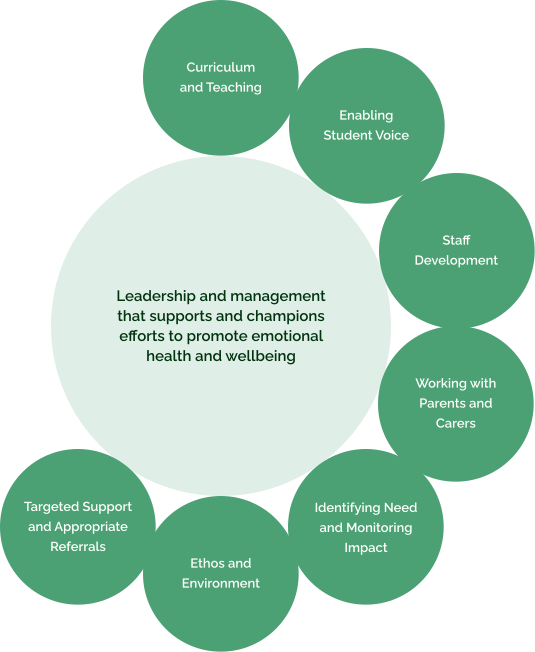
Public Health England and the Department of Education (2021) describe 8 principles for a whole setting approach to promoting emotional health and mental wellbeing. xxviiii
The 8 principles, informed by national evidence, are:
- Leadership and Management that support and champion efforts to promote emotional health and wellbeing
- Curriculum teaching and learning to promote resilience and support social and emotional learning
- Enabling student voice to influence decisions
- Staff development to support their own wellbeing and that of students
- Working with parents and carers
- Identifying need and monitoring impact of interventions
- An ethos and environment that promotes respect and values diversity
- Targeted support and appropriate referral to enable pupils get the support they need
Adopting a whole setting approach is a compassionate response.
Compassion is a sensitivity to the suffering of distress in ourselves and others with a commitment to try to relieve and prevent it. A whole school or college approach enables settings to build capacity to identify and turn towards distress whilst also taking the practical steps to relieve and prevent it.
A Compassionate School or College is made up of people who notice distress in themselves and others and act to relieve or prevent it. For this to happen, strategic change needs to occur and a whole setting approach to emotional health provides the framework through which to achieve this.
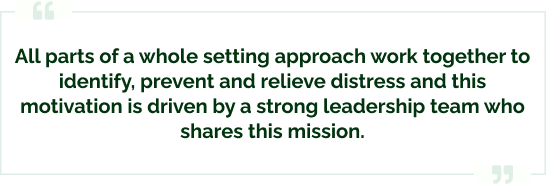
Every element of a whole setting approach to emotional health is a compassionate response. All parts of a whole setting approach work together to identify, prevent and relieve distress and this motivation is driven by a strong leadership team who shares this mission. It establishes mechanisms to hear the voice of everyone (pupils, staff, parents and carers) to learn what people need and what works, and focusses on cultivating an ethos and environment of belonging and connectedness that acts to prevent distress from arising in the first place
A whole setting approach ensures every member of the community is provided with the knowledge and skills to identify signs of distress, as well as prioritising the alleviation of distress through a comprehensive mental health pathway so everyone can receive the right support at the right time.
The Call to Action
We have heeded the call to action and created the Compassionate Schools Hub to ensure that every school and college across the Lancashire region is provided with the tools needed to respond compassionately and implement a whole setting approach to emotional health and mental wellbeing.
We know every school and college is different and therefore a one-size-fits-all approach will not work. The Compassionate Schools Hub empowers settings by providing them with a variety of tools to identify their own way forward.
It was co-created and co-designed with schools and colleges, parents and carers, and pupils to be relevant, add value and be simple to use. It focusses on bringing communities together, drawing on both national and local resources, to strengthen partnership working and ensure settings are kept informed of the support available.
We hope it is a catalyst to every school and college within Lancashire starting their journey to embedding a whole setting approach. And we at Lancashire Emotional Health and Wellbeing in Education Settings (LEHWES) are here to support every step of this process through our consultation, training, networking events and much more.
Our vision is that we build a Lancashire-wide community committed to cultivating compassionate whole school and college approaches so that together we can identify, prevent and alleviate distress for all.
References
i Newlove-Delgado, T., Marcheselli, F., Williams, T., Mandalia, D., Dennes, M., McManus, S., Savic, M., Treloar, W., Croft, K. & Ford, T. (2023). Mental Health of Children and Young People in England, 2023. Leeds: NHS England.
ii Millar, R., Quinn, N., Cameron, J. & Colson, A. (2020). Considering the evidence of the impacts of lockdown on the mental health and wellbeing of children and young people within the context of the individual, the family and education. Glasgow: Mental Health Foundation.
iii Social Metrics Commission (2024). Measuring Poverty 2024: A report of the Social Metrics Commission. Accessed at:https://socialmetricscommission.org.uk/
iv Chollet, D., Turner, A., Marquez, J., O'Neill, J. & Moore, L. (2024). The Good Childhood Report 2024. London: The Children's Society.
v British Youth Council, Youth Select Committee (2024). The impact of the cost of living crisis on young people. London: UK Parliament.
vi Children’s Commissioner (March 2024). Children's mental health services 2022-2023. London: Children's Commissioner.
vii Garratt, K., Kirk-Wade, E. & Long, R. (2024). Children and young people's mental health: policy and services (England). London: House of Commons Library.
viii Schlack, R., Peerenboom, N., Neuperdt, L., Junker, S. & Beyer, A. K. (2021). The effects of mental health problems in childhood and adolescence in young adults: Results of the KiGGS cohort. Journal of Health Monitoring, 6(4), 3-19.
viiii Public Health England (2014). The link between pupil health and wellbeing and attainment: A briefing for head teachers, governors and staff in education settings. London: Public Health England.
x The Academy of Medical Sciences (2024). Prioritising early childhood to promote the nation’s health, wellbeing and prosperity. London: The Academy of Medical Sciences.
xi Whear, R., Marlow, R., Boddy, K., Ukoumunne, O. C., Parker, C., Ford, T., ... & Stein, K. (2014). Psychiatric disorder or impairing psychology in children who have been excluded from school: A systematic review. School Psychology International, 35(5), 530-543.
xii Kessler, R. C., Berglund, P., Demler, O., Jin, R., Merikangas, K. R. & Walters, E. E. (2005). Lifetime prevalence and age-of-onset distributions of DSM-IV disorders in the National Comorbidity Survey Replication. Archives of General Psychiatry, 62(6), 593-602.
xiii United Nations General Assembly (1989). Convention on the Rights of the Child. Paris, France: United Nations.
xiv Department for Education (2014). Keeping children safe in education: statutory guidance for schools and colleges. London: Department for Education.
xv Education Support (2024). Teacher Wellbeing Index 2024. London: Education Support.
xvi McLean, D., Worth, J. & Smith, A. (2024). Teacher Labour Market in England: Annual Report 2024. Berkshire: National Foundation for Educational Research.
xvii Department for Education (2024). Working lives of teachers and leaders: wave 2 summary report. London: Department for Education.
xviii Health and Safety Executive (2024). Work-related stress, depression or anxiety statistics in Great Britain, 2024. Accessed at:https://www.hse.gov.uk/statistics/assets/docs/stress.pdf.
xviiii Education Support (2023). Teaching: the new reality. London: Education Support.
xx Harding, S., Morris, R., Gunnell, D., Ford, T., Hollingworth, W., Tilling, K., ... & Kidger, J. (2019). Is teachers’ mental health and wellbeing associated with students’ mental health and wellbeing? Journal of Affective Disorders, 242, 180-187.
xxi Kidger, J., Gunnell, D., Biddle, L., Campbell, R. & Donovan, J. (2009). Part and parcel of teaching? Secondary school staff's views on supporting student emotional health and well-being. British Educational Research Journal, 36(6), 919-935.
xxii Jennings, P. A. & Greenberg, M. T. (2009). The prosocial classroom: Teacher social and emotional competence in relation to student and classroom outcomes. Review of Educational Research, 79(1), 491-525.
xxiii Sisask, M., Värnik, P., Värnik, A., Apter, A., Balazs, J., Balint, M., ... & Wasserman, D. (2014). Teacher satisfaction with school and psychological well-being affects their readiness to help children with mental health problems. Health Education Journal, 73(4), 382-393.
xxiv Cornelius-White, J. (2007). Learner-centered teacher-student relationships are effective: A meta-analysis. Review of Educational Research, 77(1), 113-143.
xxv Roorda, D. L., Koomen, H. M., Spilt, J. L. & Oort, F. J. (2011). The influence of affective teacher-student relationships on students' school engagement and achievement: A meta-analytic approach. Review of Educational Research, 81(4), 493-529.
xxvi Spilt, J. L., Koomen, H. M. & Thijs, J. T. (2011). Teacher wellbeing: The importance of teacher–student relationships. Educational Psychology Review, 23, 457-477.
xxvii Milatz, A., Lüftenegger, M. & Schober, B. (2015). Teachers' relationship closeness with students as a resource for teacher wellbeing: A response surface analytical approach. Frontiers in Psychology, 6, 1-16.
xxviii National Institute for Health and Care Excellence (2022). Social, emotional and mental wellbeing in primary and secondary education. [NICE: G223].
xxviiii Public Health England, Department for Education and Children and Young People’s Mental Health Coalition (2021). Promoting children and young people’s mental health and wellbeing. A whole school or college approach. London, England: HM Government.
xxx Department for Education (2014). Mental health and behaviour in schools: departmental advice for school staff. London: Department for Education.
xxxi Weare, K. (2015). What works in promoting social and emotional wellbeing and responding to mental health problems in schools? Advice for schools and framework document. London: National Children's Bureau.